
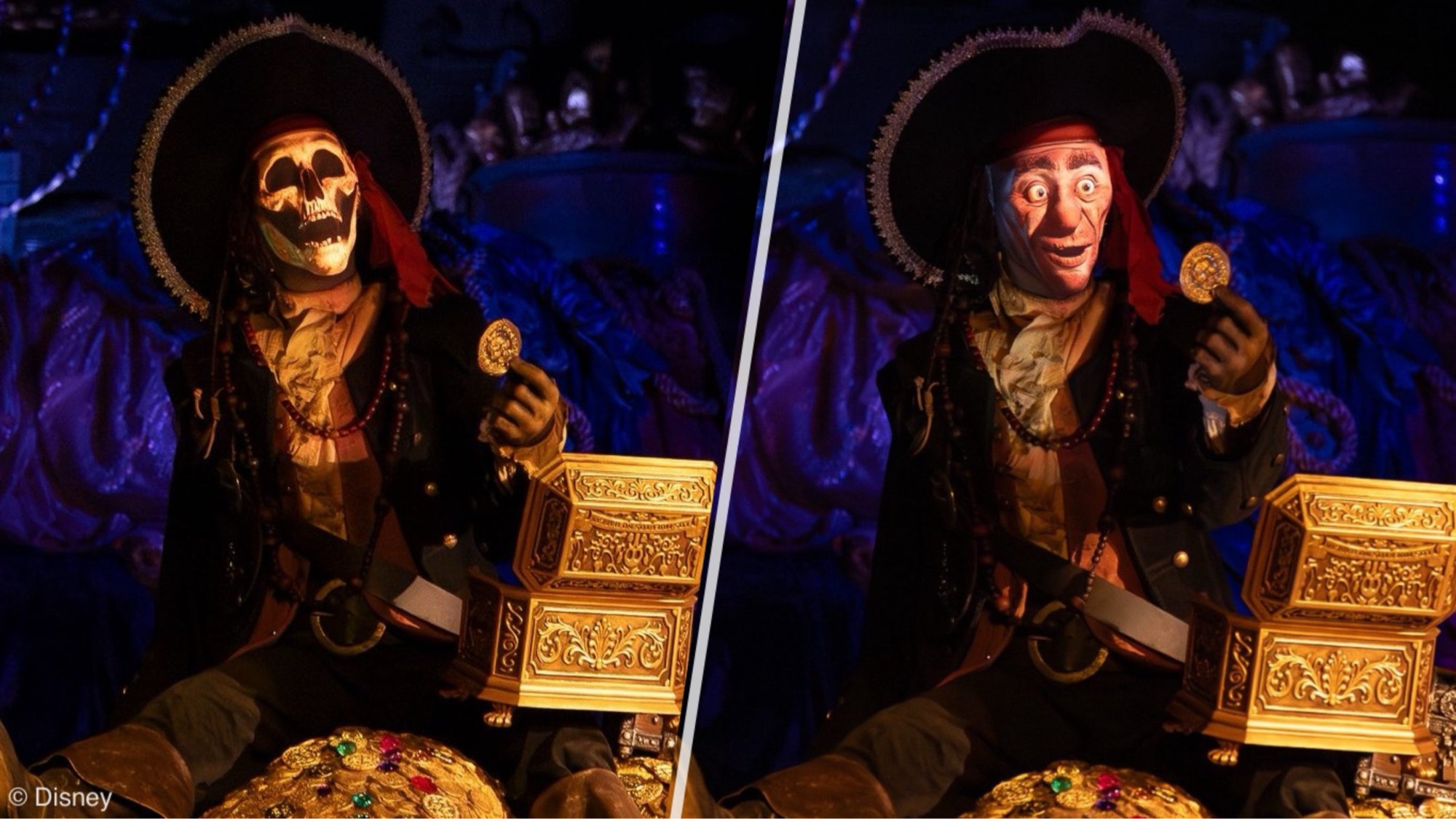
Now, Disney has completely reimagined that moment.
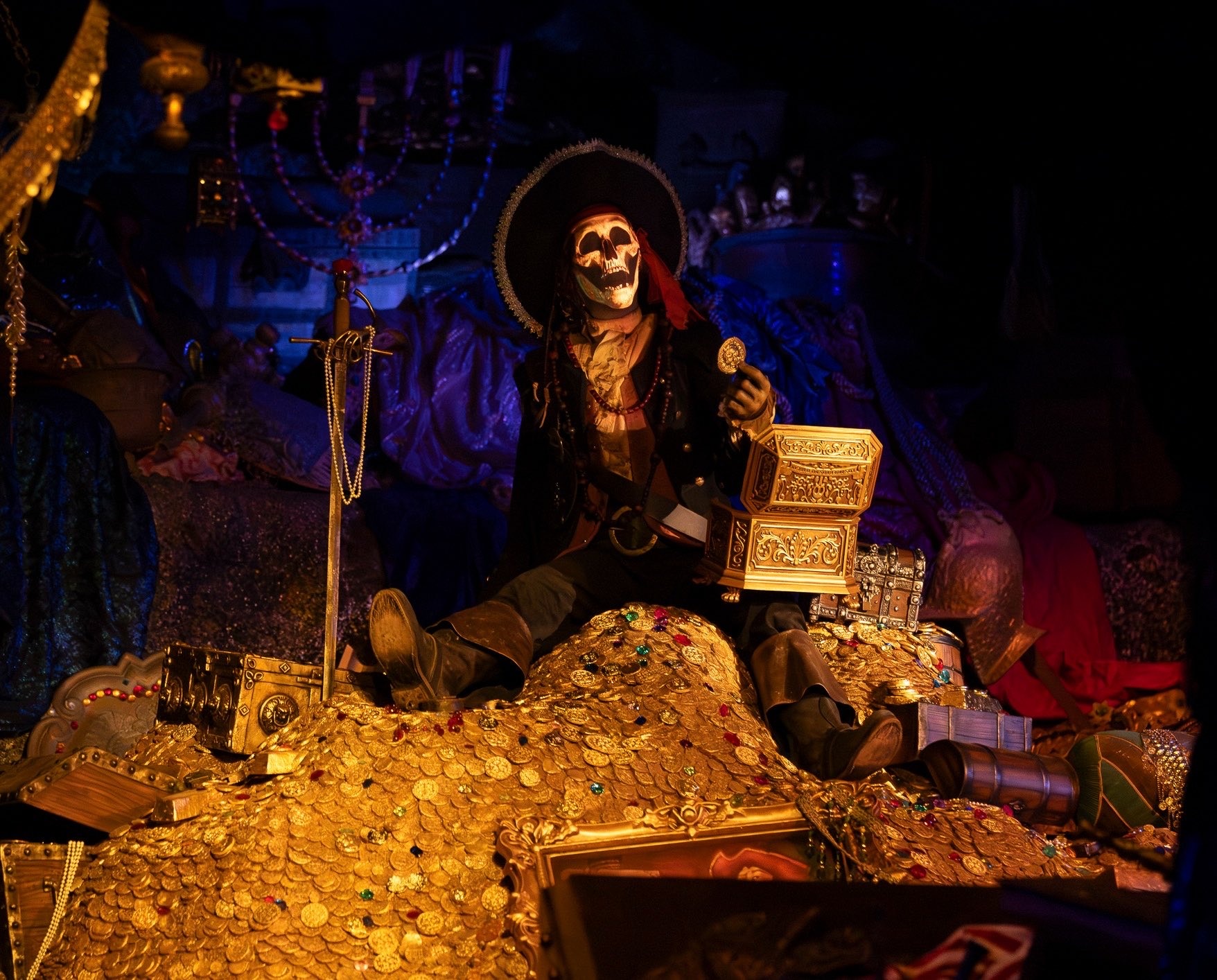
The new pirate begins as a flesh-and-blood buccaneer before lifting a cursed gold coin. Within seconds, his face transforms into a decaying skeleton before returning to human form as the curse is broken, repeating the sequence as guests float past.
It’s the first time Disney has introduced this style of projection-enhanced Audio-Animatronic into one of its attractions, and from a technological perspective it’s undeniably impressive.
Rather than relying solely on mechanical facial movements, Disney has combined traditional animatronics with highly sophisticated projection mapping, allowing the pirate to undergo a transformation that simply wouldn’t be possible using conventional mechanics alone.
It’s exactly the sort of technological leap that Walt Disney himself would probably have applauded.
A bold place to debut new technology
However, the choice of attraction is perhaps even more interesting than the technology itself.
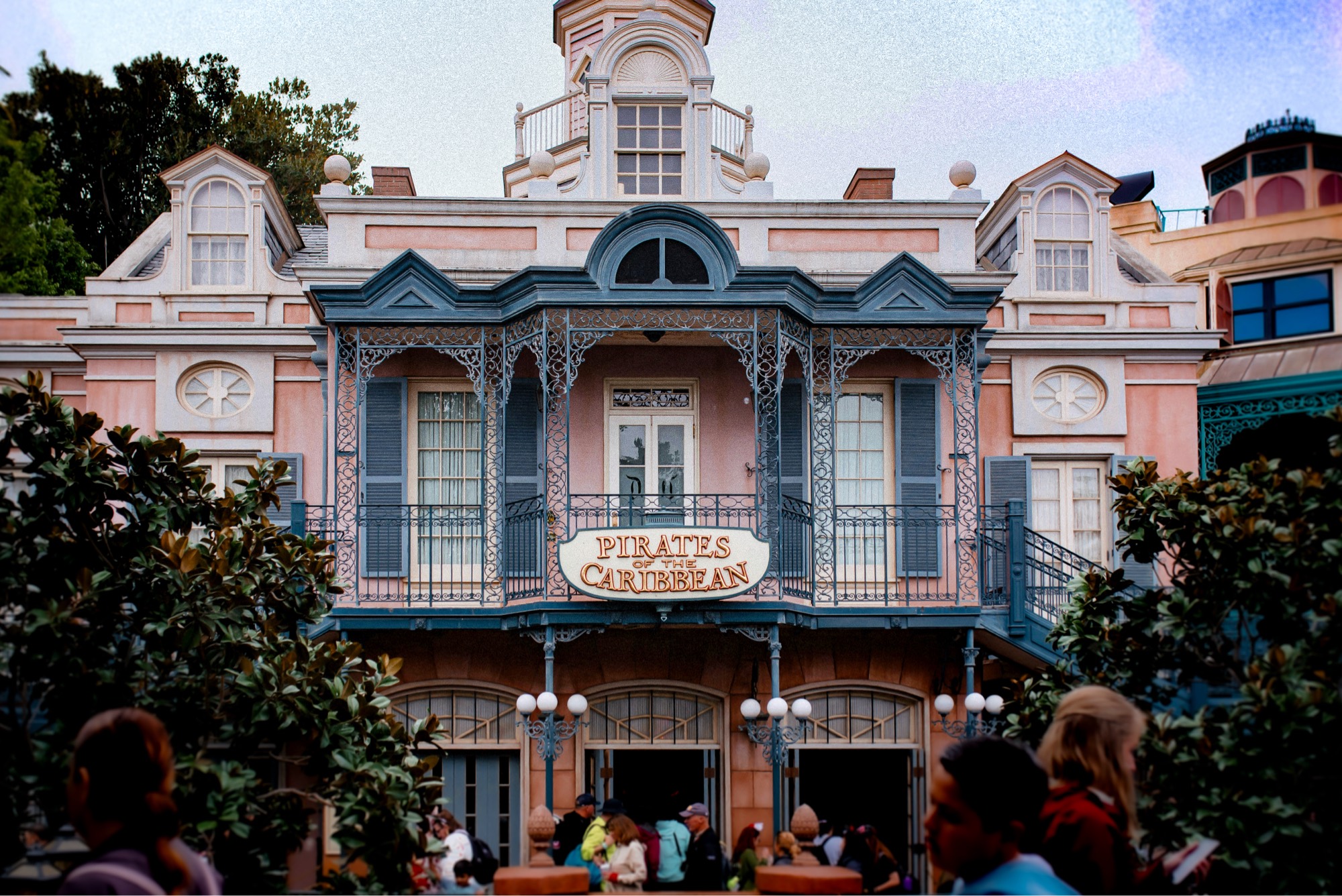
Pirates of the Caribbean isn’t just another Disney ride.
It’s arguably the most iconic dark ride ever built, personally overseen by Walt Disney before his death and regarded by many as the benchmark for themed entertainment. Every scene, every skeleton and every flickering lantern has become part of Disney history.
That means every change is scrutinised. Introducing an entirely new style of Audio-Animatronic into such a beloved attraction feels like an incredibly bold decision.
Had this figure debuted inside a brand-new attraction, guests may simply have accepted it as part of the experience. Instead, Disney has chosen one of its most cherished attractions as the proving ground for technology that still feels very much in its first generation.
We’ve seen this before…
Interestingly, this isn’t Disney’s first experiment with projection-based faces.
When Frozen Ever After opened at EPCOT in 2016, Anna and Elsa featured rear-projected digital faces. The technology allowed the characters to display a huge range of animated expressions that closely resembled their appearance in the films.
It was certainly ambitious. However, many guests felt the faces never quite blended with the rest of the figures. While the costumes, hair and bodies looked beautifully sculpted and naturally lit, the faces often appeared noticeably brighter and flatter than everything surrounding them.
Rather than disappearing into the illusion, the technology sometimes became the very thing guests noticed most.
Earlier this year, Disney quietly replaced the projection faces with more traditional mechanically animated faces. Imagineering never officially confirmed the reason for the change, but many Disney fans viewed it as an acknowledgement that the technology hadn’t quite achieved the realism expected inside a Disney attraction.

Has the technology come far enough?
That history inevitably raises questions about Disneyland’s new pirate. Unlike Frozen Ever After, this isn’t simply a projected face. Disney has cleverly blended projection mapping with a physical Audio-Animatronic to create an effect that couldn’t realistically be achieved through mechanical engineering alone.
It’s a genuine technical achievement. Yet watching early videos of the figure, there are still moments where the projected face appears brighter than the rest of the pirate. Your eye is naturally drawn towards the illuminated facial features, making you aware that you’re looking at projected light rather than a fully physical face.
Perhaps that’s simply the compromise required to create such a dramatic transformation. Or perhaps it suggests Disney still has some way to go before projection-based faces become completely indistinguishable from traditional mechanical animation.
The greatest themed entertainment effects are often the ones you never notice. When the technology disappears completely, you’re simply immersed in the story. At times, the new pirate still feels like you’re watching the technology itself.
Innovation shouldn’t stop
None of this is to criticise Disney for continuing to innovate. Disney parks have always been built on experimentation. From the original Audio-Animatronics in the 1960s to today’s trackless ride systems and incredibly lifelike figures, Imagineering has never stood still.
Every breakthrough has started somewhere.
The new cursed pirate may well represent the future of Audio-Animatronics, opening the door to expressions, transformations and storytelling moments that traditional mechanical figures could never achieve.<br>
But perhaps there was a less risky place to debut it. When you’re experimenting on one of the greatest attractions ever built, expectations are impossibly high.
Final thoughts
The new transforming pirate is fascinating to watch, and there’s no denying the engineering achievement behind it.
However, given Disney’s own history with projection faces, it’s fair to ask whether this technology is quite ready for centre stage on one of the company’s most treasured attractions.
The effect is impressive. The ambition is commendable. But the brightly illuminated projection still feels slightly at odds with the beautifully engineered physical figure surrounding it.
Perhaps this is simply the next step in the evolution of Audio-Animatronics, and in a few years’ time we’ll look back at this pirate as the moment everything changed.
Or perhaps, much like Frozen Ever After before it, Disney will continue refining the technology until the projection disappears completely into the illusion.
Only time – and guest feedback – will tell.
What do you think? Is Disney’s new transforming pirate a glimpse into the future of Audio-Animatronics, or do traditional mechanical faces still offer the most convincing illusion? Let us know in the comments below.




Leave a Reply